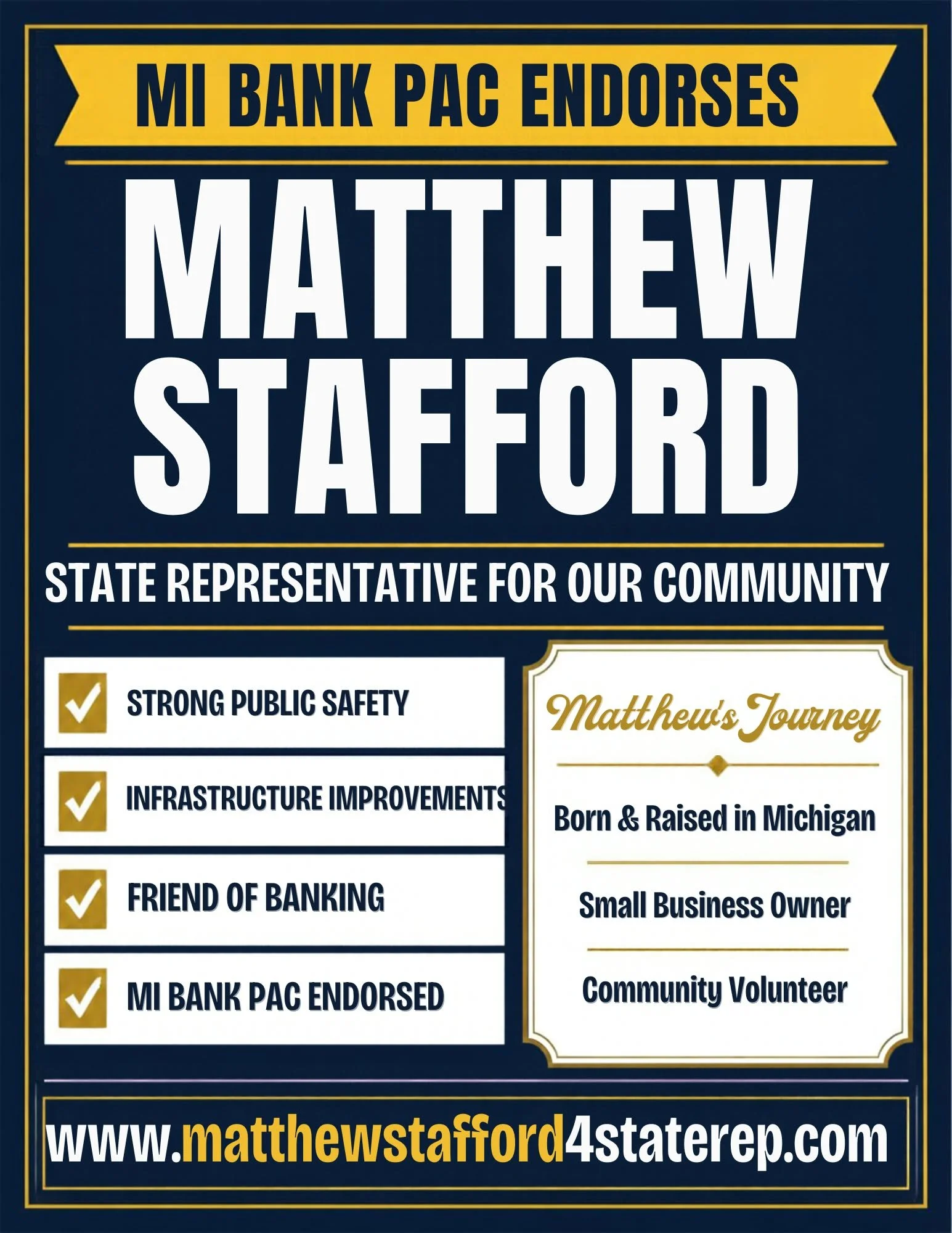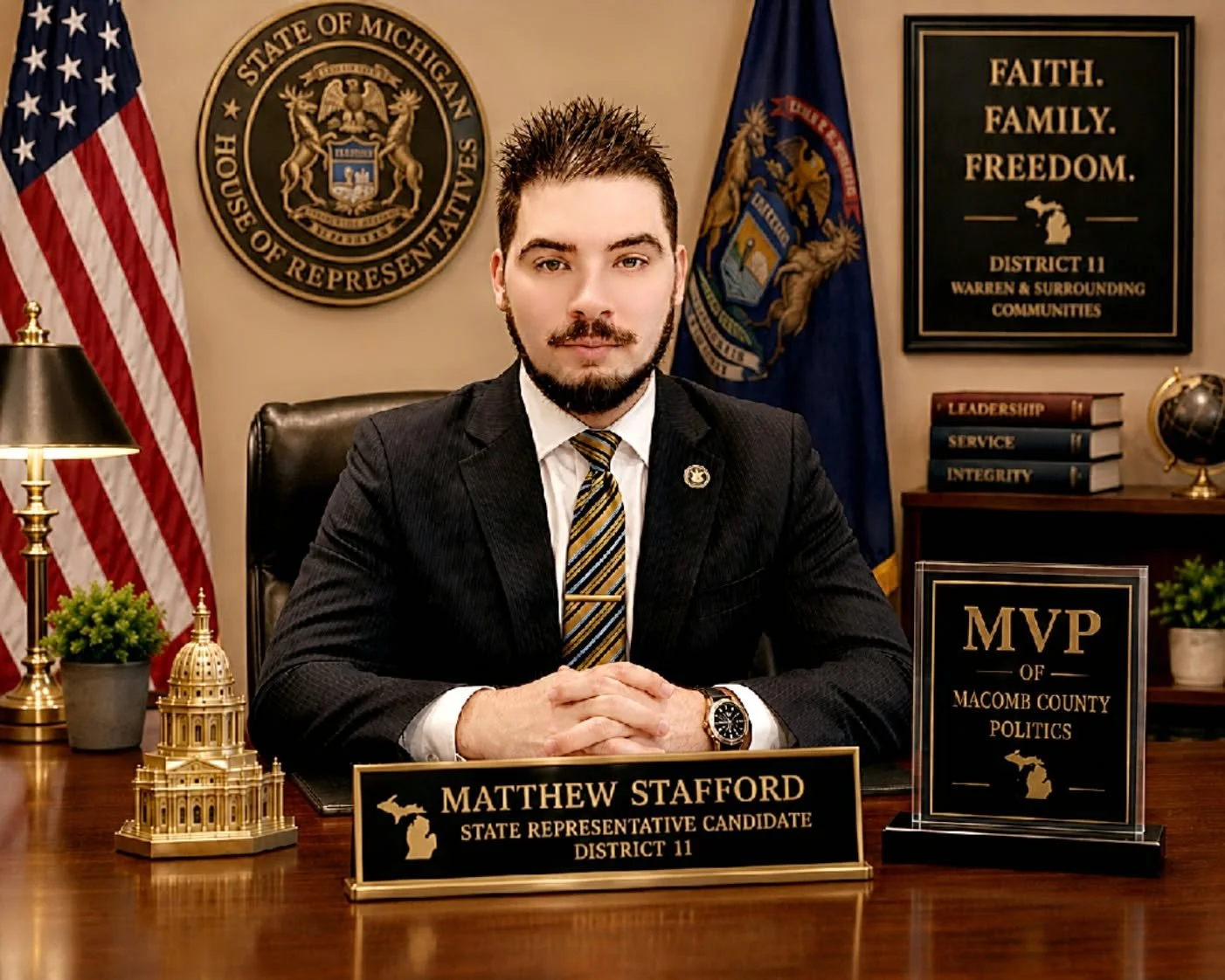
MCRGO ENDORSED
NRA— AQ RATED HIGHEST RATE FOR NON INCUMBENT
FOR IMMEDIATE RELEASE
Matthew Stafford Announces Agricultural and Economic Development Commission
WARREN, MI — August 14, 2026 — Republican Michigan House District 11 candidate Matthew Stafford today announced the creation of the Agricultural and Economic Development Commission, a new initiative focused on strengthening agriculture, small business, manufacturing, investment, and job creation throughout Michigan. Stafford said the commission will bring together agricultural stakeholders, farmers, business owners, manufacturers, economic-development leaders, and community representatives to identify practical policies that can encourage investment and expand economic opportunity.
“Michigan has everything we need to be an economic powerhouse,” Stafford said. “We have hardworking families, world-class agriculture, manufacturers, entrepreneurs, and small businesses. What we need is leadership willing to bring those people together and remove the barriers that stand between them and opportunity.” The commission will focus on several key priorities: - Supporting Michigan farmers and the agricultural economy. - Expanding opportunities for small businesses and manufacturers. - Encouraging private-sector investment and job creation. - Identifying unnecessary regulatory and bureaucratic barriers to growth. - Strengthening local economies and communities. - Developing practical policy recommendations for the Michigan Legislature. Stafford emphasized that agriculture and economic development should not be treated as separate issues.
“When agriculture succeeds, communities succeed,” Stafford said. “When small businesses grow, families have more opportunities. When manufacturers invest, Michigan workers benefit. We need an economic-development strategy that recognizes how connected all of these pieces are.” The commission will seek input from people working directly in agriculture, business, manufacturing, and economic development and will use that input to develop policy recommendations.
“My goal is simple: bring the people who actually create jobs and build our communities into the policymaking process,” Stafford said. “I don't want government making decisions in a vacuum. I want farmers, business owners, manufacturers and working families at the table.” Stafford is the Republican nominee for Michigan House District 11 and is seeking to represent residents of the district in the Michigan House of Representatives.
###
Media Contact: mtstafford2@gmail.com
Matthew Stafford for State Representative Michigan House District 11

About Matthew Stafford
Matthew Stafford is a community leader, a US Marine Vet, nonprofit founder, and candidate for State Representative in District 11 who is running to fight for the people of Warren and surrounding neighborhoods, families who work hard, play by the rules, and deserve a government that finally works for them.
Matthew isn’t a career politician. He’s someone who has spent his time in the community, working directly with families who are struggling to keep up with rising costs, finding stable jobs, and putting food on the table. He’s seen firsthand what many in District 11 already know: too many people are being left behind while politicians argue and do nothing. He’s running to change that. Rooted in the Community District 11 isn’t just where Matthew is running—it’s the kind of community that shaped who he is. Through his nonprofit work, Matthew has helped local families facing real challenges: Parents choosing between groceries and bills, Workers trying to find stable, good-paying jobs, Families searching for safe, affordable housing, He’s stepped in to help provide food, connect people to employment opportunities, and guide families toward stability not from behind a desk, but face-to-face.
That experience gives him something most politicians lack: a real understanding of what people here are going through every day. Fighting for Working Families, Matthew’s campaign is built around the issues that matter most in District 11: Lowering Costs & Expanding Opportunity. Families in Warren are feeling squeezed—from groceries to gas to housing. Matthew will fight for policies that: Support job growth and small businesses, Expand workforce training and skilled trade opportunities, Make it easier not harder for people to get ahead, build Safer Neighborhoods, And Public safety is non-negotiable. Every family deserves to feel safe in their home and community.
Matthew supports:
Strong support for law enforcement
Community-based solutions that prevent crime before it starts
Accountability
Resources to keep neighborhoods secure Real Help, Not Empty Promises. Matthew has already been doing the work—helping families access food, jobs, and housing. In Lansing, he’ll push for: Practical solutions to homelessness and housing instability, Better access to job placement and career pathways, Efficient use of resources so help actually reaches people, and Leadership You Can Count On.
Matthew’s leadership didn’t start with this campaign—it’s been a consistent part of his life. Named Student of the Year at Cincinnati State for his commitment to excellence and service.
Studied business and finance at Davenport University, bringing a practical, results-oriented mindset, has Served as Lieutenant Governor of Student Government, advocating for students and driving change. Helped bring student government representation to the Warren campus—ensuring local voices were heard He doesn’t wait for change—he builds it.
Guided by Faith, Family, and Freedom Matthew stands firmly on the values that matter to so many families in District 11: Faith – A foundation of integrity, purpose, and accountability.
Family – The backbone of every strong community
Freedom – The right to work hard, feel safe as hes pro 2nd amendment, building a better future, These aren’t political talking points—they’re how he lives his life and how he’ll serve in office, A Different Kind of Representative.
People describe Matthew as kind, driven, and committed—but what sets him apart is simple: he shows up. He listens. He works. He follows through. District 11 deserves a representative who: Is present and accessible—not distant, Understands real struggles—not just policy talking points, Focuses on solutions—not political games, Matthew is running to be that representative.
Building a Stronger District 11 Matthew’s mission is clear: to give back to the community that has given him so much by fighting for real opportunities and a better future for every family. This campaign is about: Restoring trust in leadership Delivering real results for working people, Making sure no one in this community is overlooked or forgotten
Join the Movement This isn’t about politics—it’s about people. Matthew Stafford is ready to bring energy, accountability, and a servant’s heart to Lansing. Matthew has also recently stated he plans to donate half of his annual Salary to the community of District 11 to ensure the people get the help they deserve, showing he is here for the people not these lansing insiders or himself. he is the ONLY candidate that has made this pledge.
But real change takes a community. Join the campaign. Get involved. Be part of building a stronger District 11
Father’s Rights & Child Support Reform
Michigan State House District 11 Policy Platform
Executive Summary
This proposal outlines a reform agenda aimed at modernizing Michigan’s family court and child support system to ensure fairness, accountability, and equal treatment of both parents—while prioritizing the best interests and financial stability of children. The current system is widely criticized for:
Inconsistent custody outcomes
Financial penalties that do not reflect actual ability to pay
Administrative enforcement that can escalate poverty Limited
enforcement of parenting time
rights for non-custodial parents, This reform package seeks to balance parental rights, child welfare, and fiscal responsibility.
Core Policy Pillars
1. Equal Presumption of Shared Parenting Goal: Establish a legal preference for shared parenting time when both parents are fit. Reforms: Create a rebuttable presumption of 50/50 parenting time in custody decisions. Require courts to justify deviations with written findings based on child safety or abuse risk. Standardize custody determinations across counties to reduce inconsistency Rationale: Research in family law generally shows children benefit from stable, frequent contact with both parents when safe and appropriate.
2. Child Support Modernization Goal: Align child support obligations with real-world financial capacity and parenting time. Reforms: Adjust support calculations to reflect actual overnight parenting time Require real-time income verification updates (not outdated annual assumptions) Cap support obligations to prevent orders that exceed realistic ability to pay. Include consideration of new dependents and household financial burden Rationale: The current formula can create arrears accumulation that becomes unpayable, undermining long-term compliance.
3. Enforcement Reform & Debt Relief Pathways Goal: Shift from punitive enforcement to compliance-based recovery. Reforms: Reduce automatic license suspensions for child support arrears when partial payment history exists. Create structured “compliance plans” that prevent incarceration-driven job loss. Establish a child support debt restructuring program for long-term arrears. Prioritize wage attachment at reasonable percentages rather than fixed punitive levels Rationale: Excessive enforcement can reduce earning capacity, which ultimately reduces child support recovery.
4. Parenting Time Enforcement Goal: Ensure custody orders are actually enforced. Reforms: Strengthen penalties for repeated denial of court-ordered parenting time. Allow expedited hearings for interference cases. Create enforceable remedies including makeup parenting time. Improve tracking of custody violations through standardized reporting Rationale: Court orders without enforcement undermine trust in the legal system.
5. Mediation & Early Resolution First Approach Goal: Reduce litigation and emotional conflict in custody disputes. Reforms: Require mandatory mediation before contested custody trials (except abuse cases) Expand access to neutral family mediation services Incentivize cooperative parenting agreements through reduced court costs Rationale: Litigation increases costs, delays outcomes, and often intensifies conflict.
6. Transparency & Judicial Accountability Goal: Improve consistency and public confidence in family courts. Reforms: Publish anonymized data on custody outcomes by county Require written justification for non-standard custody rulings Standardize guidelines across judicial districts
Economic & Social Impact- Increased workforce participation among non-custodial parents, Reduced incarceration and enforcement costs, Improved child well-being through increased parental involvement, Lower long-term dependency on public assistance programs.